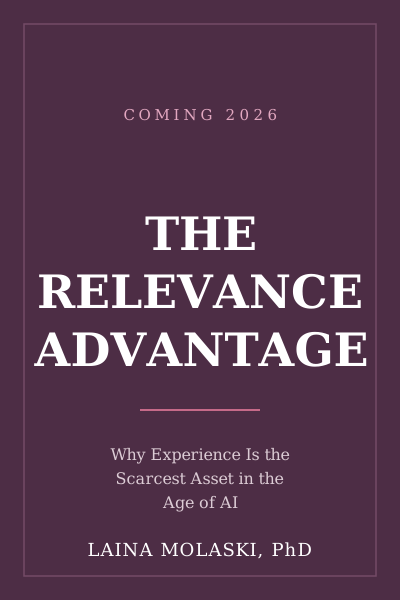
Coming 2026
THE RELEVANCE ADVANTAGE
Why Experience Is the Scarcest Asset in the Age of AI
Every technology wave before this one charged an operating tax that favored the young. This one doesn't.
Most advice tells experienced professionals to catch up, retrain, and compete with people half their age on AI's terms. That advice is backwards. This book argues that judgment, context, and pattern recognition, the things only time and repetition can build, are exactly what AI cannot replace and increasingly cannot function without. The professionals who understand this aren't scrambling. They're positioned to win.
Join the waitlist
Be first to know when The Relevance Advantage is available. No spam, ever.
The Reframe
For the first time, the technology reshaping work rewards what you already have instead of taxing you for what you lack.
Every prior wave of workplace technology demanded that you learn an arbitrary new interface — command lines, menus, keyboard shortcuts, syntax. That learning curve was a tax, and it fell hardest on the people with the most experience and the least appetite for relearning the basics. AI inverts this. Its interface is plain language, so the cost of operating it collapses toward zero — and what's left, the ability to judge whether the output is any good, is precisely what a long career builds.
“Judgment, context, and pattern recognition are exactly what AI cannot replace — and increasingly cannot function without.”
— from The Relevance Advantage
What's Inside
Five ideas that reframe the whole conversation
The core throughlines of the argument — why experience is an asset, not a liability, in the age of AI.
01
The Operating Tax
“Every technology wave before this one charged a toll in arbitrary interface knowledge, and paying it rewarded exactly what young people have more of: time and appetite for novelty. This wave's interface is a sentence. The tax just went to zero.”
When operating the tool stops being the hard part, the advantage shifts to whoever can tell good output from bad — a skill that compounds with experience, not against it.
02
The Four Groups
“Being able to operate an AI tool and being able to evaluate what it gives you are two different skills. Only one of them is scarce, and it's the one experience builds.”
Sorting people by operate versus evaluate reveals four very different positions in the AI economy — and shows why the most valuable quadrant is the one the market keeps overlooking.
03
Recognition Over Instruction
“AI follows instructions. Experienced judgment recognizes patterns before they're obvious, the difference between knowing what to ask for and knowing what's actually right.”
Prompting is instruction; expertise is recognition. The professionals who thrive are the ones who can see what a model missed — and know what to do about it.
04
Relational Capital
“Decades of relationships, trust, and dormant ties can't be prompted into existence. AI has no shortcut for a network built over a career.”
The relationships you've earned over decades are a moat no model can replicate — and in an AI-saturated market, that trust becomes more valuable, not less.
05
Invisible, Not Obsolete
“The real risk facing experienced professionals was never irrelevance. It's being overlooked, which is a visibility problem, not a competence one.”
The threat isn't that your skills stopped mattering — it's that they stopped being seen. Fixing visibility is a solvable problem, and the book shows how.

About the Author
A practitioner's account, written by someone who has spent a career at the intersection of people, work, and change.
Laina Molaski holds a PhD in Business with a specialization in Human Resources, an MBA, and an MFA in creative writing. She brings more than 25 years of HR experience across corporate, consulting, and academic settings. She teaches adult learners, works with organizations through a fractional HR consulting practice, and writes about how experienced professionals can stay indispensable as the nature of work changes.
Written for Working professionals navigating AI, HR leaders rethinking talent and experience, and career-focused higher education.
Be first in line
Join the waitlist and I'll email you the moment The Relevance Advantage is available — plus early excerpts along the way.